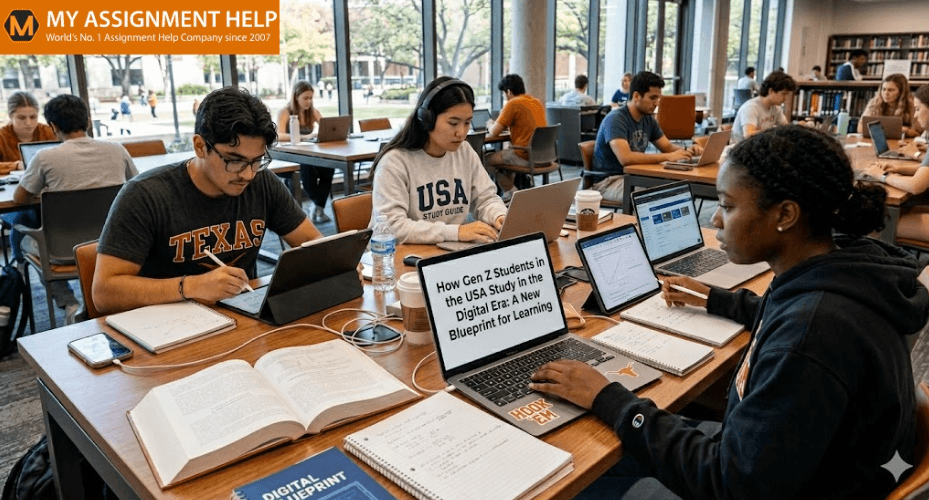
How Gen Z Students in the USA Study in the Digital Era: A New Blueprint for Learning

The traditional image of a student hunched over a heavy textbook in a silent library is rapidly becoming a relic of the past. For Generation Z—those born between the mid-to-late 1990s and the early 2010s—the educational landscape in the United States has undergone a seismic shift. As the first generation of “digital natives,” Gen Z students don’t just use technology; they live within it.
From high schools in suburban Chicago to university campuses in California, the way students consume information, collaborate on projects, and prepare for exams has been completely redefined by the digital era. This blog explores the unique study habits of Gen Z in the USA and how they are leveraging digital tools to navigate their academic journeys.
1. The Death of the Physical Textbook: Digital-First Resources
For high school and college students today, the weight of a backpack is no longer measured in pounds of paper, but in the processing power of a laptop or tablet. Gen Z students overwhelmingly prefer digital textbooks (e-books) over their physical counterparts.
The reasons are practical: searchability, portability, and cost-effectiveness. Features like “Command + F” to find a specific keyword or the ability to sync highlights across devices have made the old-school highlighter nearly obsolete. According to recent educational surveys in the US, over 80% of college students now utilize at least one digital learning platform daily.
Some platforms provide supplementary video content that breaks down complex subjects—ranging from biology to sophisticated finance research topics — into digestible “micro-learning” segments. This shift reflects Gen Z’s preference for visual and interactive content over dense, linear text. They aren’t just reading history; they are watching high-definition documentaries and interactive timelines that make the past feel present.
2. The Rise of “StudyTube” and Social Learning
One of the most fascinating developments in the digital era is the emergence of “StudyTube” and “StudyGram.” High school and college students are turning to YouTube, TikTok, and Instagram not just for entertainment, but for academic motivation and peer-to-peer teaching.
Channels featuring “Study With Me” videos—where creators film themselves studying for hours in real-time—provide a sense of “body doubling” and communal focus. For a student in a dorm room in Boston, watching a peer study in Seattle creates a virtual library environment that boosts accountability. On TikTok, #StudyHacks offers quick tips on everything from mnemonic devices to Excel shortcuts. This generation treats learning as a social, communal experience, even when they are physically alone.
3. Collaboration in the Cloud and Remote Readiness
Gone are the days of meeting at a coffee shop to huddle over a single poster board. Gen Z collaboration happens in real-time on the cloud. Tools like Google Workspace (Docs, Sheets, Slides) and Microsoft Teams are the backbones of American group projects.
Students can contribute to a presentation simultaneously from different time zones, leaving comments and resolving edits in seconds. For more complex engineering or coding projects, platforms like GitHub and Discord serve as hubs for communication and version control. This digital collaboration mirrors the modern remote-work environment, effectively preparing students for the professional world they will enter after graduation. They are learning “soft skills”—like digital etiquette and asynchronous communication—long before they receive their first paycheck.
4. AI and the Evolution of Research
In 2026, you cannot talk about Gen Z study habits without mentioning Artificial Intelligence (AI). While there is much debate regarding academic integrity, most US students view AI as a powerful tutor rather than a shortcut.
Gen Z integrates AI into their workflow in several key ways:
- Outlining: Using LLMs to brainstorm essay structures and overcome “blank page syndrome.”
- Summarization: Condensing 40-page academic journals into five key takeaways to save time.
- Personal Tutoring: Asking AI to explain difficult physics or organic chemistry concepts in “layman’s terms.”
- Editing: Using tools like Grammarly and Hemingway to refine their tone and clarity in real-time.
However, this has also led to a greater need for academic support services. Many students find themselves overwhelmed by the sheer volume of information available online. This is where professional guidance becomes crucial. For those struggling to balance high-level coursework with extracurriculars, seeking finance assignment help at Myassignmenthelp.com has become a common strategy to ensure they meet the rigorous standards of the American education system and maintain a competitive GPA.
5. Gamification: Turning Grades into Games
Gen Z grew up with smartphones in their hands, making them highly responsive to gamified environments. Apps like Quizlet and Kahoot! are staples in US high school classrooms. By turning vocabulary drills or history dates into competitive games with leaderboards and “streaks,” these tools tap into the dopamine-reward system. For the Gen Z student, the repetitive nature of memorization is made bearable—and even fun—when it feels like leveling up in a video game.
6. The “Second Screen” Phenomenon and Digital Fatigue
A hallmark of Gen Z learning is the “multi-screen” approach. It is common to see a student with a lecture video playing on a laptop, a digital notebook open on a tablet, and a smartphone nearby for quick fact-checking. While older generations might view this as a lack of focus, many Gen Z students argue that it allows for a more holistic intake of information.
However, this has also led to a rise in “digital fatigue.” In response, a counter-movement has emerged where students prioritize “Deep Work”—a concept popularized by Cal Newport. To combat the constant pings of social media, students are increasingly using:
- The Pomodoro Technique: Studying in 25-minute bursts followed by 5-minute breaks.
- Focus Apps: Using apps like “Forest,” where a virtual tree grows only if you stay off your phone.
- Digital Minimalism: Intentionally scheduling “analog hours” to read physical books or hand-write notes to improve retention.
See also: How Minnesota Businesses Improve Google Rankings
7. Personalization and Self-Paced Learning
In the traditional American classroom, every student moves at the same speed. The digital era has changed that. With access to recorded lectures and online modules, students can now engage in “asynchronous learning.”
If a high schooler in New York excels at math but struggles with English, they can speed through the math modules and spend double the time on literature videos, pausing and rewinding until the concept clicks. This level of personalization helps accommodate different learning styles—visual, auditory, and kinesthetic—that the traditional “chalk and talk” method often ignored.
8. Mental Health and the Digital Balance
Studying in the digital era isn’t without its challenges. The “always-on” nature of digital education can lead to burnout. US universities have seen a surge in students seeking help for “Zoom fatigue” and the pressure of maintaining a perfect academic persona online.
Consequently, Gen Z is also leading the charge in using technology for mental health. They use meditation apps like Headspace or Calm to decompress after a long night of screen time. They are more vocal than any previous generation about the need for a healthy study-life balance, often advocating for “wellness days” and mental health breaks within the academic calendar.
9. Leveraging Online Academic Support
The complexity of the modern curriculum, especially in STEM and advanced humanities, often exceeds what a single teacher or a 45-minute class period can provide. Consequently, Gen Z students are proactive about finding the help they need.
Whether it’s finding a tutor on a specialized platform or utilizing comprehensive academic writing services, they understand that “doing it all yourself” isn’t always the most efficient path to success. Myassignmenthelp.com offers specialized support that helps students bridge the gap between their classroom notes and the high-quality assignments required for top-tier university admissions. In an era of hyper-competition, having a professional “editor” or “strategy consultant” for your assignments is seen as a smart investment in one’s future.
10. The Future: VR, AR, and the 2027 Job Market
As we look forward, the integration of Virtual Reality (VR) and Augmented Reality (AR) into the American study routine is the next frontier. Imagine a history student “walking” through the streets of ancient Rome via a headset, or a biology student dissecting a virtual frog in 3D.
This immersion is more than just a novelty; it is preparing students for a 2027 job market that will prize “Agentic Literacy”—the ability to work alongside AI and navigate complex digital ecosystems. For Gen Z, the boundary between the physical and digital worlds is increasingly porous. Education is no longer a place you go (a school building), but a state of being that you access through your devices.
Conclusion
Gen Z students in the USA are pioneers of a new educational frontier. By embracing AI, social learning, and cloud-based collaboration, they have turned the “digital era” into a personalized, interactive, and global classroom. While the challenges of digital distraction and burnout remain, the resilience and tech-savviness of this generation ensure they are well-equipped for the future. As they move from high school to the workforce, their ability to master these digital tools will be their greatest competitive advantage.
Frequently Asked Questions
Q.1 How is Gen Z different from previous generations in their study habits?
Gen Z is the first generation to be “born digital.” Unlike Millennials, who adapted to the internet, Gen Z has never known a world without smartphones or instant access to information. This has led to a preference for asynchronous learning—the ability to learn at their own pace—and a heavy reliance on visual and interactive content like YouTube and TikTok over traditional textbooks.
Q.2 What are the most popular digital study tools for US students in 2026?
The modern American student uses a “tech stack” for school. This typically includes Google Workspace for collaboration, Quizlet or Kahoot! for gamified memorization, and Notion or GoodNotes for digital note-taking. Additionally, focus apps like Forest and AI-integrated tools like Grammarly have become essential for maintaining productivity.
Q.3 How do US students manage “digital burnout”?
Digital fatigue is a significant concern for Gen Z. Many students now utilize “Deep Work” strategies, such as the Pomodoro Technique, to balance high-intensity focus with frequent breaks. There is also a growing trend of “digital minimalism,” where students intentionally set aside their devices to engage in analog study methods, such as handwriting notes, to improve cognitive retention and reduce eye strain.
Q.4 Why are academic support services from myassignmenthelp.com becoming more popular?
As the US curriculum becomes increasingly rigorous—particularly in STEM and Advanced Placement (AP) courses—students often face a “knowledge gap” that standard classroom hours cannot fill. Professional support services provide the specialized, one-on-one guidance necessary to master complex topics and maintain a high GPA. In a competitive academic environment, these services act as a strategic resource for students aiming for top-tier university admissions.
About the Author: Drake Miller
I am a passionate blog author and associated with Myassignmenthelp.com, dedicated to guiding students toward academic success. With a strong focus on clarity, research, and practical learning strategies, I create insightful content that simplifies complex topics. As a mentor, I strive to empower learners with the right tools and confidence to excel in their studies while developing essential skills for long-term personal and professional growth.